How precisely can carbon ink be printed into the closely spaced patterns a strain gauge needs?
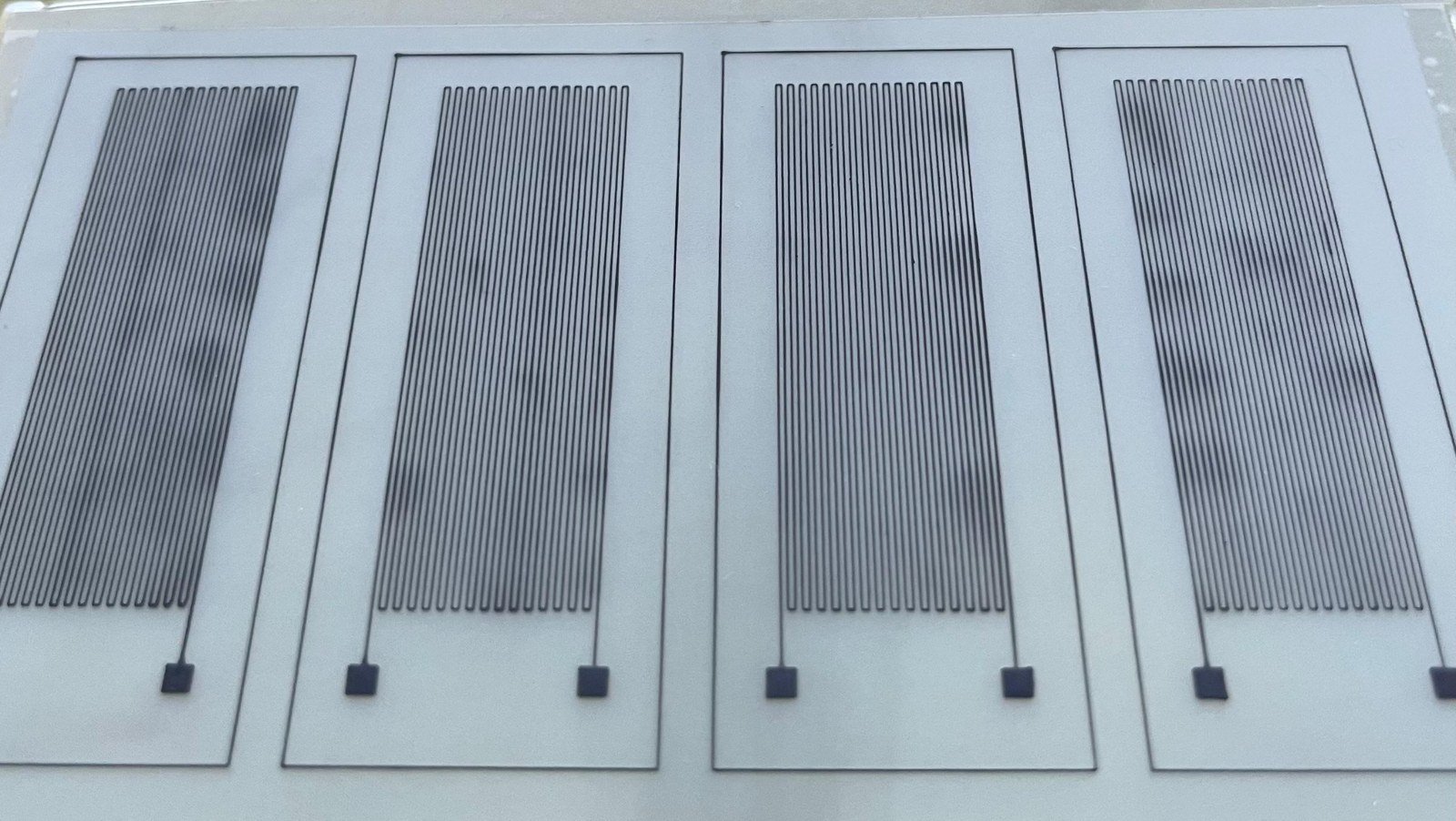
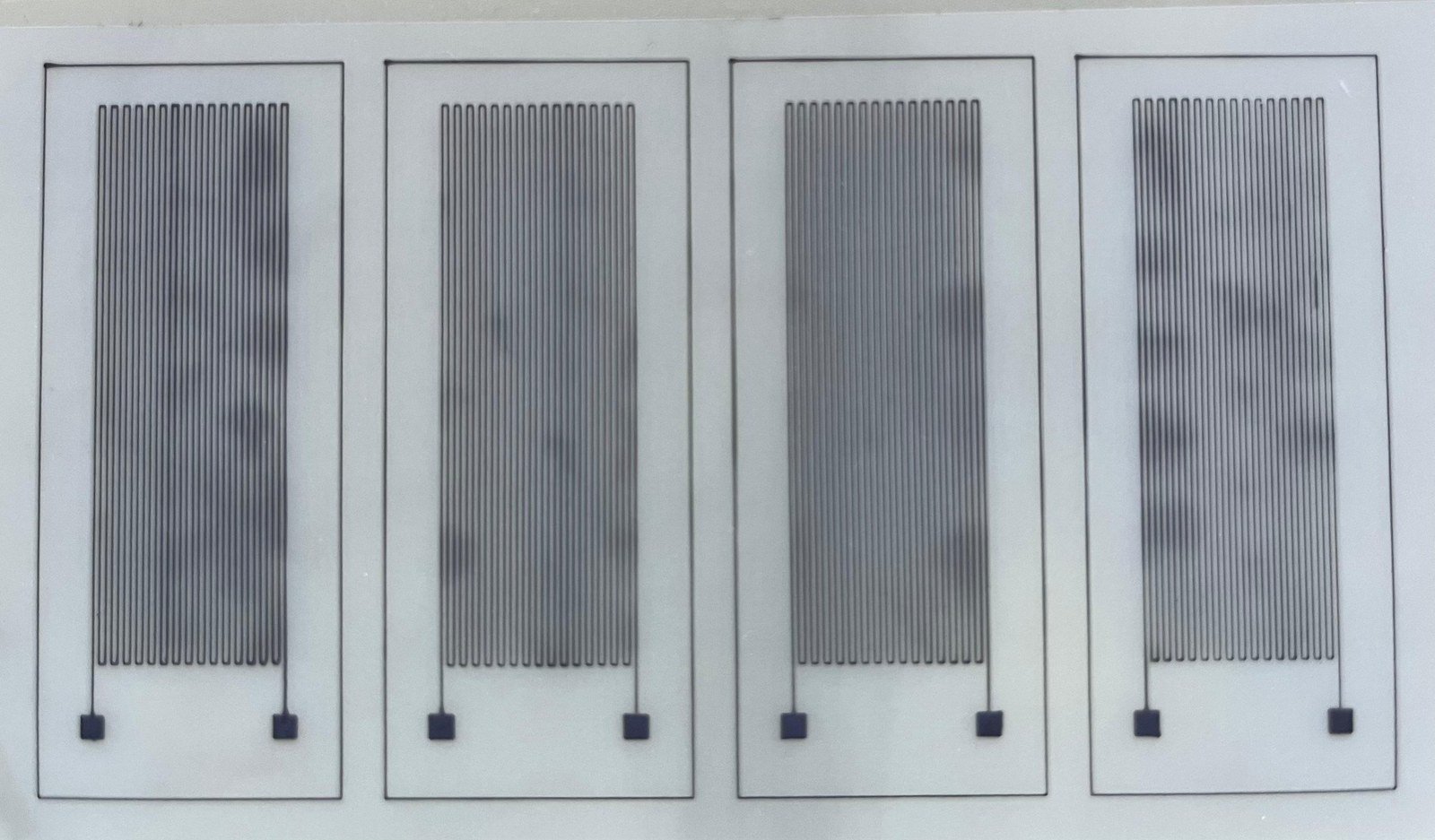
Monobee printed four meander-shaped strain gauge patterns with Saralon carbon humidity ink on the same flexible film sheet. The structures were compared visually and examined under an optical microscope.
The smallest printed feature documented in the microscope images measured 127.85 µm. The study focused on the fabrication capabilities that printed strain sensing builds on, rather than on a fully characterized sensor.
Purpose
Strain gauges respond to mechanical deformation through a change in their electrical properties. In a resistive strain gauge, the sensing element is a conductive pattern whose resistance changes as it is stretched or compressed.
Printing these patterns calls for careful control of trace dimensions, spacing and continuity. This study examined how well Monobee forms fine carbon meanders with clearly defined, visually consistent features. Electrical strain response and sensitivity were outside its scope.
- Fine-line printing The achievable dimensions of carbon traces under the selected printing conditions.
- Pattern definition Separation and geometry of adjacent paths inside dense meander structures.
- Fabrication consistency Visual uniformity across several structures printed on the same substrate.
A geometry designed for strain measurement
Meander patterns fit a long conductive path into a compact area: parallel traces joined by turns form one continuous path between two terminals. In a working sensor, deformation changes the resistance of that path.
For printing, the same geometry brings four fabrication considerations, which also make it a useful test of resolution and consistency.
- 01Trace widthNarrow features need controlled deposition and suitable ink flow.
- 02Trace spacingNeighboring paths stay separated to keep the intended electrical geometry.
- 03Corner definitionThe turns between traces keep the path geometrically continuous.
- 04Pattern uniformityVariation in printed dimensions can shift the electrical behavior of the structure.
Printing carbon structures with Monobee
The patterns were printed with Monobee’s Direct Ink Writing process, depositing Saralon carbon humidity ink along digitally defined meanders. Each of the four structures has a densely arranged conductive path connected to terminal pads.
| Printing platform | Monobee |
| Technology | Direct Ink Writing (DIW) |
| Functional material | Saralon carbon humidity ink |
| Substrate | Flexible polymer film |
| Tip | 100 µm metal-coated tip |
| Printed geometry | Meander strain gauge patterns |
| Test structures | Four |
| Characterization | Optical microscopy |
| Evaluation focus | Feature size, pattern definition, visual consistency |
- 01Pattern designMeander layouts with closely spaced parallel traces and terminal pads were prepared digitally.
- 02Carbon ink depositionMonobee deposited the carbon ink along the digitally defined geometries.
- 03Sample preparationThe printed structures went through the material processing steps before inspection.
- 04Optical inspectionTrace dimensions, spacing and meander turns were examined under an optical microscope.
- 05Dimensional evaluationSelected features were measured to document the dimensions of the deposited carbon.
Consumables
Fine-line carbon printing.
Optical microscopy showed well-defined conductive paths with measurable features in the micrometer range. Individual traces, the spacing between them and the connecting turns could all be examined in the images.
Measured on the printed carbon pattern under an optical microscope. It is an individual feature measurement, not a guaranteed minimum printing specification.
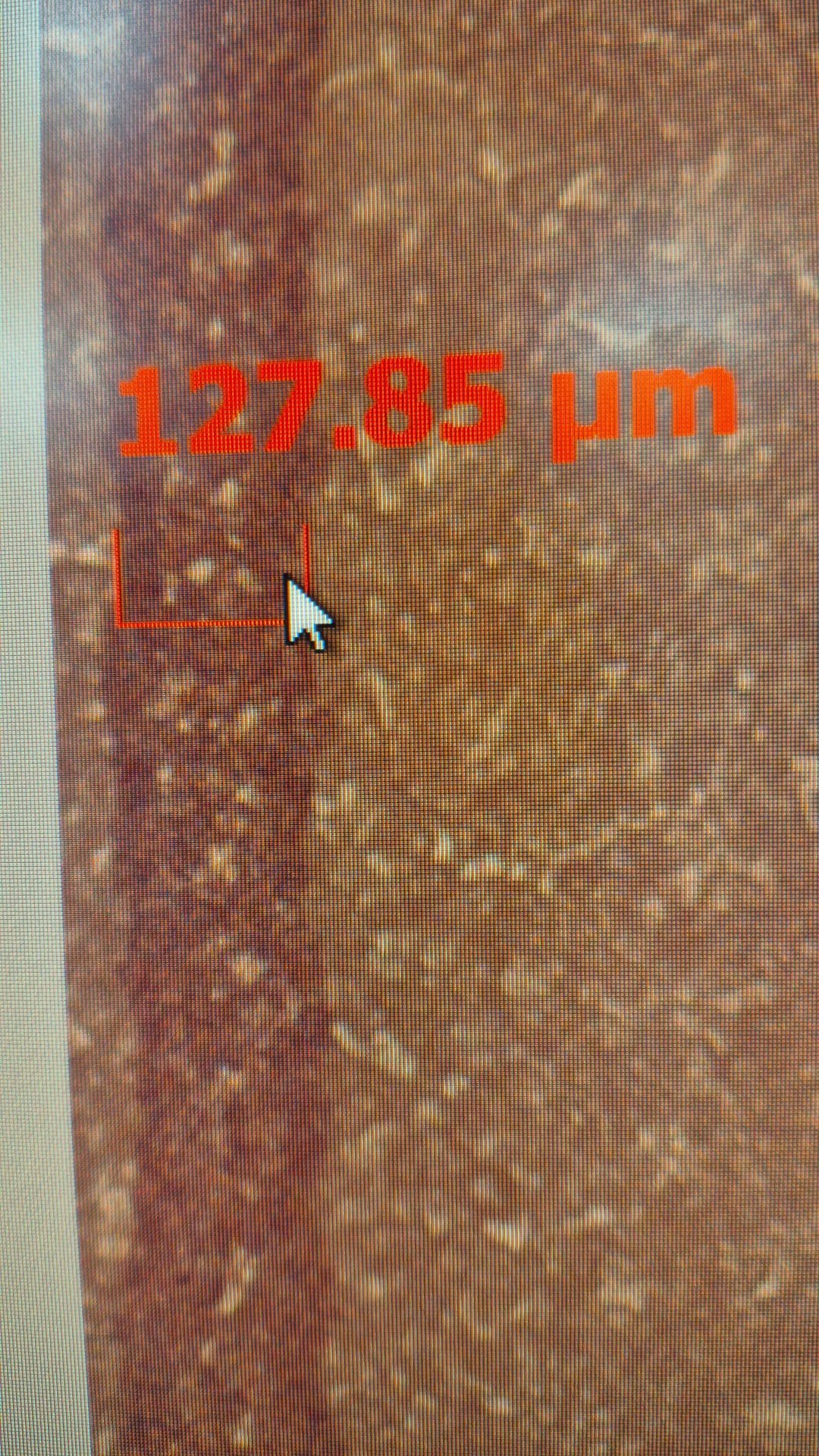
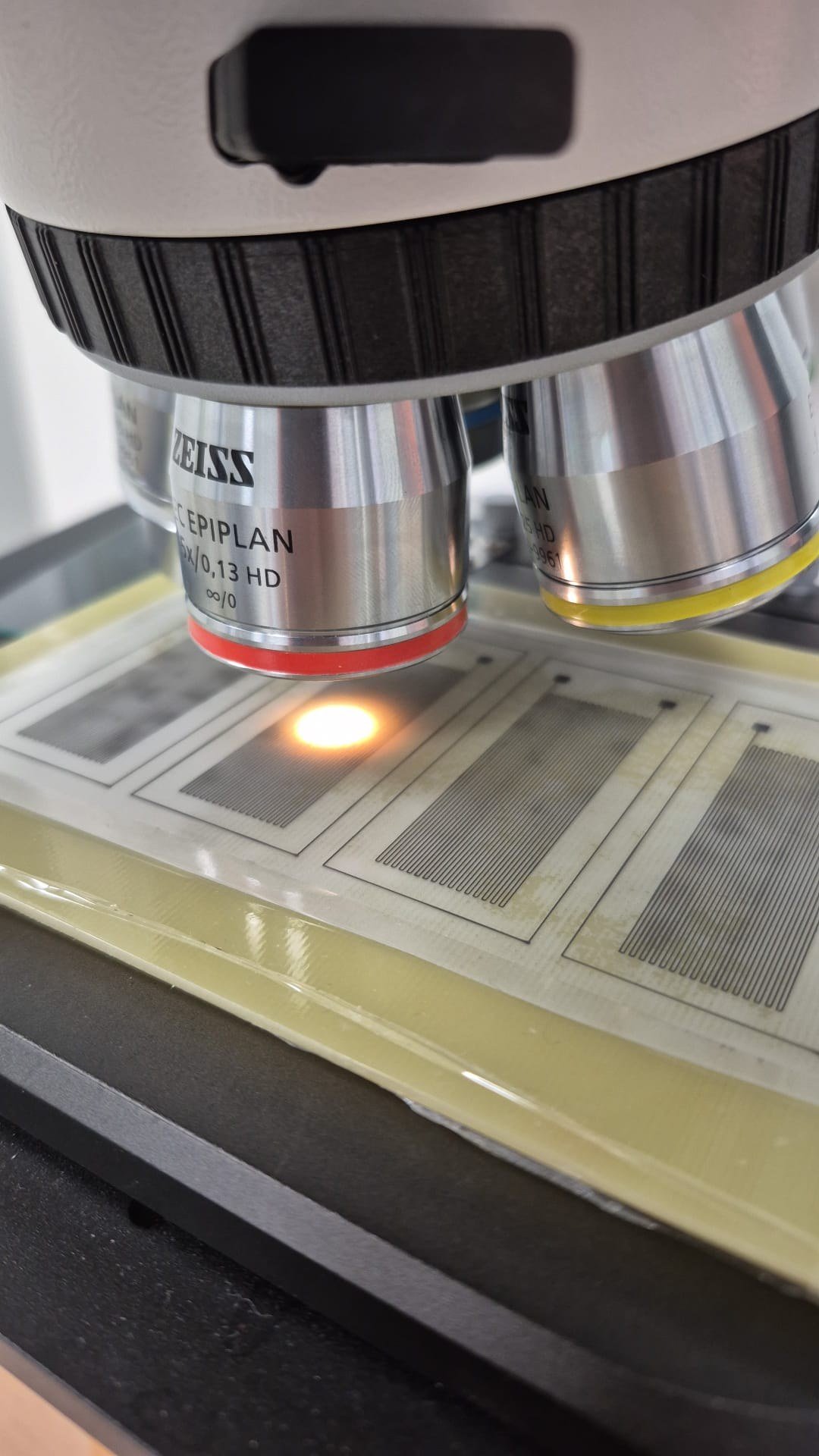
The samples show recognizable, densely arranged meander geometries. Monobee deposited carbon ink into closely spaced conductive patterns with fine geometric features.
Visual inspection showed the intended geometry reproduced across all four structures, an initial indication of consistent pattern formation under the selected conditions.
Quantitative repeatability, electrical continuity and long-term performance call for additional measurements.
Fine features matter. Consistent patterns matter more.
A single narrow line is only one part of a printed strain gauge. The sensing geometry needs many closely spaced traces, controlled turns and one continuous conductive path, and small dimensional differences can influence resistance and device behavior.
The meander patterns made it practical to examine how carbon ink deposits across repeated fine features. Together with the four-structure sample sheet, the observations lay a foundation for electrical and mechanical characterization.
The next step is electrical characterization
A resistive strain gauge is usually described by its relative change in resistance under deformation, summarized as the gauge factor. Further work can cover resistance measurements, controlled bending or tensile tests, linearity, hysteresis and repeated loading cycles.
- R₀
- initial electrical resistance
- ΔR
- resistance change during deformation
- ε
- applied mechanical strain
Simpler meanders, silver and carbon
The four-pattern sheet is the most detailed design in this series. Alongside it, simpler strain gauge layouts with fewer meander legs have been printed with both silver and carbon inks on thin, flexible films that bend easily by hand.
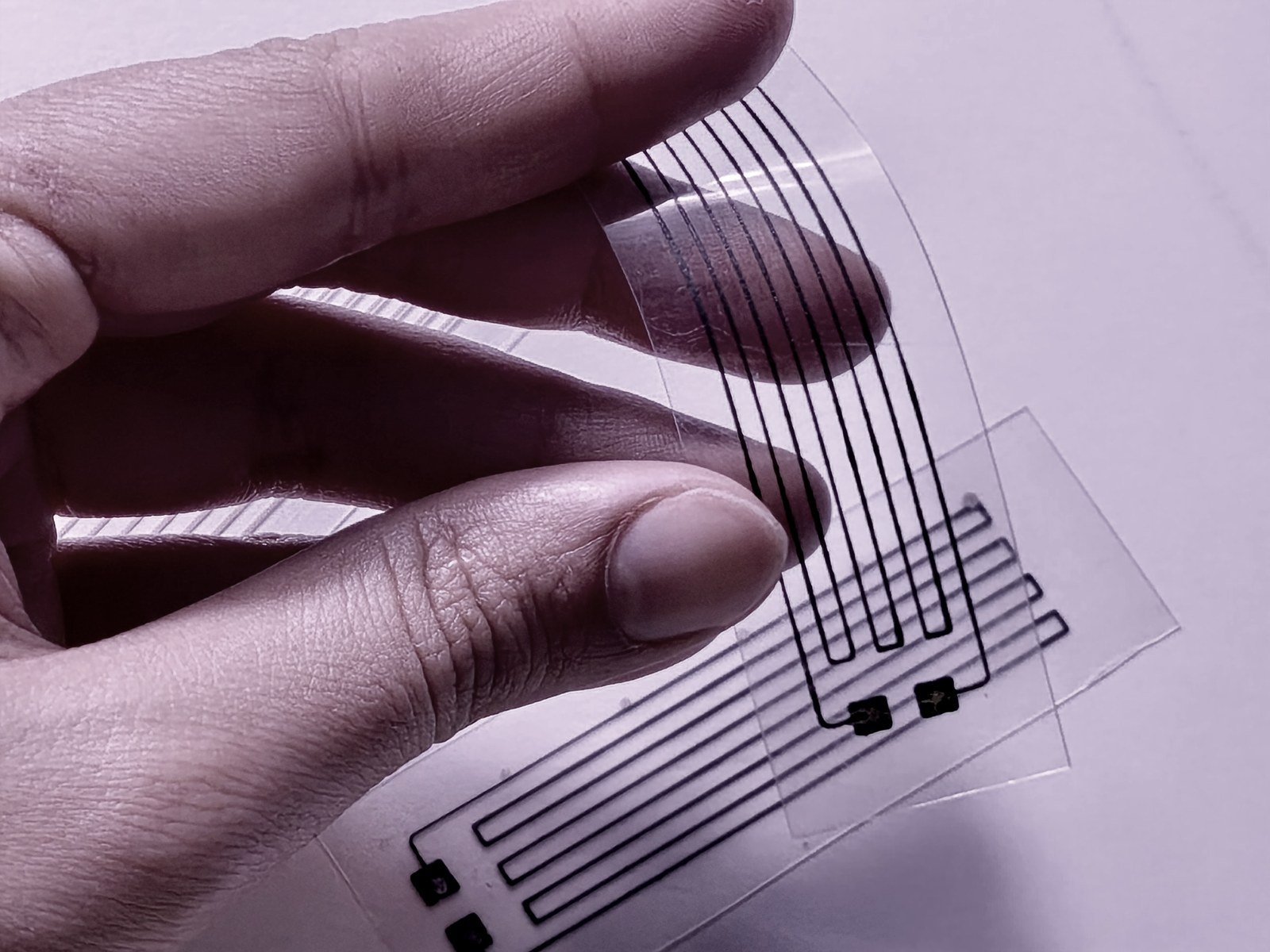
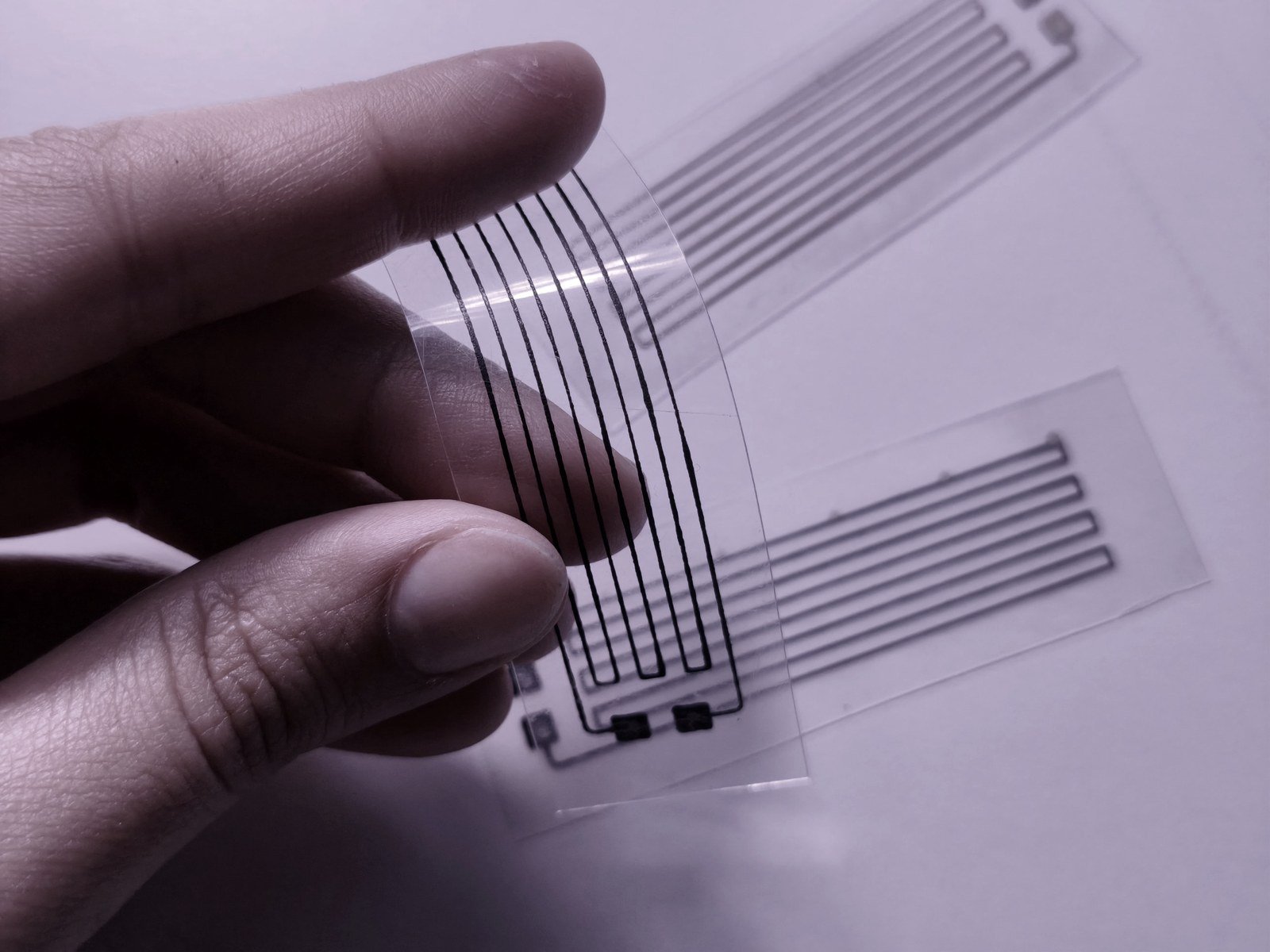
Explore geometry and materials together
Printed strain sensors depend on the interplay of material, pattern geometry and substrate. Monobee prints custom conductive structures straight from digital designs with compatible functional inks.
- Custom geometries Try alternative meander layouts, trace lengths and path arrangements.
- Material exploration Study the printability of carbon formulations and other compatible materials.
- Fine-feature fabrication Build closely spaced conductive structures for experimental evaluation.
- Flexible substrates Print electronic patterns on compatible polymer films.
- In-house iteration Change the digital layout and print the next version during early development.
Potential applications
- Flexible strain sensors
- Wearable electronics
- Structural monitoring
- Soft robotics
- Human–machine interfaces
- Material and sensor research
These are potential applications of printed strain gauge technology. Functional sensing performance was outside the scope of this study.
A foundation for printed strain sensing.
Four carbon meander structures were printed on flexible film with Monobee and examined by optical microscopy, with features measured down to 127.85 µm. The study shows closely spaced carbon patterns formed consistently across the sheet, ready for electrical and mechanical testing.
RELATED MATERIALS: CONDUCTIVE INKS →The strain gauge patterns were printed with Saralon carbon humidity ink.